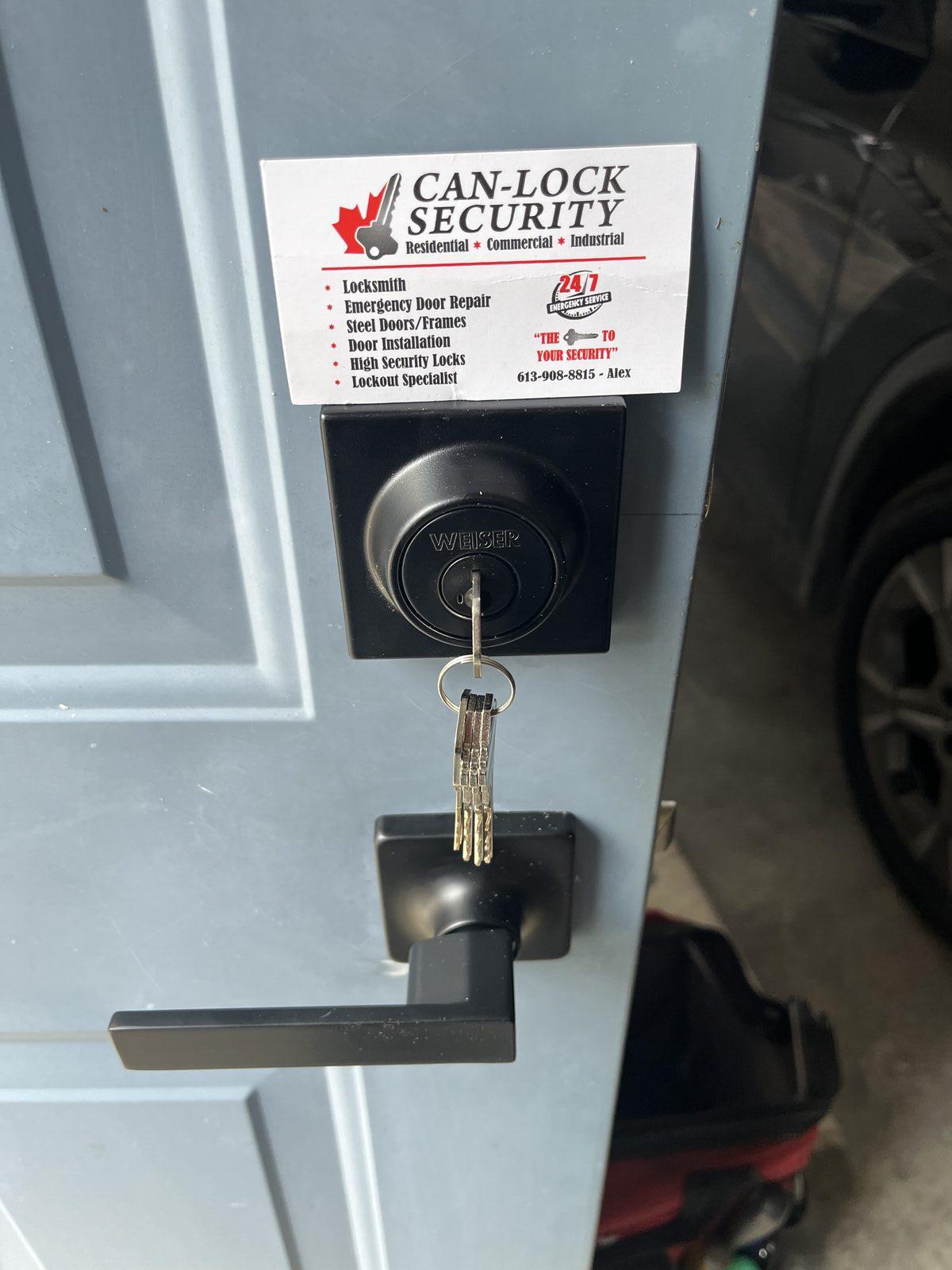
Most people interact with a door lock every single day without ever thinking about what's actually happening inside it. That's fine, right up until something needs replacing, repairing, or upgrading, and suddenly a hardware store shelf full of unfamiliar terms becomes a genuine obstacle. Here's the plain-language version.
The Core Mechanism: Pin Tumbler Locks
The large majority of residential locks use what's called a pin tumbler mechanism. Inside the cylinder are a series of spring-loaded pin pairs, each cut to a different height. When the correct key is inserted, it pushes each pin pair to exactly the right position, aligning them at what's called the shear line, which allows the cylinder to rotate and the lock to open. An incorrect key leaves at least one pin pair misaligned, blocking rotation entirely.
Knob Locks vs. Deadbolts
A knob lock is built into the door handle itself and is primarily a convenience mechanism — it keeps a door from swinging open, but the mechanism is relatively easy to defeat with basic tools or force. A deadbolt is a separate, dedicated lock installed above or below the knob, extending a solid metal bolt directly into the door frame. This is the actual security layer on most homes; a knob lock alone offers comparatively little resistance to forced entry.
What "Security Grade" Actually Means
Deadbolts are rated on a scale established by testing standards, generally described as Grade 1 through Grade 3. Grade 3 is the lightest duty, most common in budget and standard builder-grade hardware. Grade 2 sits in the middle, still common in many homes. Grade 1 is the most resistant to forced entry and is typically what's used in commercial applications, though it's increasingly available and affordable for residential upgrades too.
Single-Cylinder vs. Double-Cylinder
A single-cylinder deadbolt uses a key on the exterior side and a simple thumb-turn on the interior — no key needed to exit. A double-cylinder deadbolt requires a key on both sides, which can add security if there's a window near the door that someone could reach through, but it also means anyone inside needs a key to exit, which matters for both daily convenience and fire safety considerations.
Rekeying vs. Replacing: A Distinction Worth Knowing
Rekeying means changing the internal pin configuration of an existing lock so that old keys stop working and new ones are issued — the physical lock, deadbolt, and finish all stay exactly the same. Replacement means installing an entirely new lock. Rekeying is generally faster and less expensive, and it's the right choice when you want to control who has access without any complaint about the hardware itself. Replacement makes sense when the existing lock is worn, damaged, or you want to upgrade its style or security grade.
The Strike Plate: An Overlooked Component
The strike plate is the metal plate on the door frame that the deadbolt bolt actually extends into. Its condition and installation matter enormously for real security — a strong deadbolt paired with a strike plate secured only by short, standard screws still has a genuine weak point, since forced entry attempts often succeed by breaking through the frame around the strike plate rather than defeating the lock mechanism itself. Reinforcing this with longer screws that reach actual wall framing is one of the more affordable, meaningful security upgrades available.
Smart Locks: What Actually Changes
A smart lock replaces the method of unlocking — a code, an app, a fob, sometimes a fingerprint — while the underlying mechanical function generally stays the same as a traditional deadbolt. Most models retain a physical key override as backup. The appeal is largely about convenience and managing access without physical keys, rather than a fundamentally different security mechanism.
Keyways and Key Duplication: Why Not Every Key Can Be Copied Anywhere
The keyway is the specific shape cut into a lock cylinder that a matching key blank has to fit. Standard residential keyways are widely available, which is exactly why a basic hardware store or a locksmith can cut a duplicate without much trouble. A restricted keyway, common on higher-security cylinders, uses a shape that's only available to authorized dealers, meaning duplicates can only be made with proper authorization, often requiring the original key or documented proof of ownership. This is a deliberate security feature, not a limitation — it gives a property owner real, lasting control over who can ever obtain a working copy.
Why Two Locks That Look Identical Can Behave Very Differently
It's easy to assume any deadbolt that fits your door and matches your budget is functionally interchangeable with any other, but two locks that look nearly identical on a store shelf can have meaningfully different internal tolerances, pin configurations, and resistance to picking or manipulation. This is part of why security grade, discussed above, matters more than finish or brand recognition when it comes to actual performance under a genuine forced-entry attempt.
Why Understanding This Matters Before You Buy Anything
Knowing the difference between a knob lock and a deadbolt, understanding what a security grade actually indicates, and recognizing that the strike plate matters as much as the lock itself all help you make an informed decision rather than guessing at a hardware store shelf. If you're ever unsure what your specific situation actually needs, that's exactly the kind of question worth asking a locksmith directly rather than assuming.
If you're considering a lock upgrade for your home, our Deadbolt Installation page walks through the practical decisions involved.